To start a motorcycle riding group, define what kind of riding it is for, recruit five to ten committed riders you already know, agree on meeting cadence and safety norms before your first ride, and give the group a consistent public meeting point. From there, an app like 2 Wheels in Common makes it easy to manage membership, post rides, and keep riders coming back.
Define the group's purpose and identity
Every riding group that lasts has a clear reason to exist. "Motorcycle group" is not an identity. "Saturday morning ADV rides out of the east side" is. Decide what kind of riding the group is built around: sportbike canyon runs, cruiser coffee stops, ADV exploration, or just anyone who wants to ride on a weekend. Pick a name and a home region. A specific identity does two things at once: it tells the right riders this group is for them, and it tells everyone else which group they should be looking for instead.
This is also the point to decide how the group will plan rides. Loosely scheduling a group ride by text thread works for three people once. It does not work for a group that wants to exist past its second month.
Recruit your first riders
Do not wait for a perfect founding roster. Start with riders you already know: a few regulars from your usual rides, coworkers who ride, or people you have nodded to at the same gas station for years. Five to ten riders who actually show up beats fifty who joined and never RSVP to anything. Momentum, not headcount, is what keeps a group alive past the first few weeks.
Once you have a core group, the easiest way to grow is to make the first ride good enough that people bring a friend. A well-run, well-communicated ride is the best recruiting tool you have.
Set group norms before the first ride
Vague expectations are where riding groups quietly fall apart. Before your first group ride, agree on:
- Meeting cadence: weekly, biweekly, or monthly, and roughly what day
- Skill-level expectations: beginner-friendly, experienced-only, or mixed with a slower B group
- Pace and regrouping: how the group handles turns, hills, and riders who fall behind
- Safety culture: no rider left behind, mandatory gear standards, and what happens if someone breaks down
Put this in writing somewhere new riders can read it before they show up. It is much easier to set the tone once, up front, than to correct it mid-ride.
Pick a public, safe meeting point
Riders who do not know each other well showing up at someone's house is a bad first impression and a real safety concern. Meet at a gas station, a parking lot, or a trailhead: somewhere public, easy to find, and easy to describe. A consistent, public meeting point lowers the barrier for a new rider to show up to their first ride with your group.
How 2 Wheels in Common supports a new group
2 Wheels in Common is built for exactly this stage: the point where a loose group of riders needs a home instead of a group chat that gets buried. You can create a group in the app, scoped to your region, so rides you post show up to the riders who joined instead of getting lost in a citywide feed. As the group grows, you can create and organize other groups too, whenever you want.
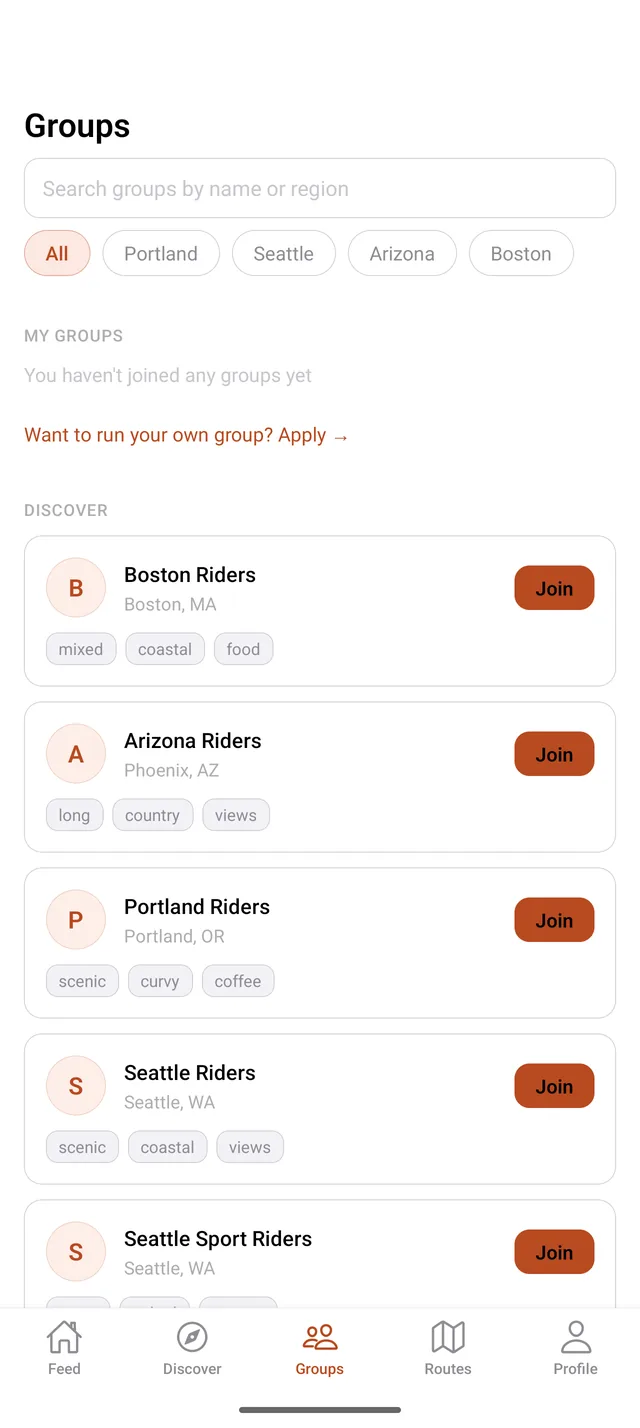
Once your group exists, posting a ride takes the meeting point, date, route, and RSVP list out of a scattered text thread and puts it somewhere every member can see it, including a safety advisory if a meeting point looks like a private address instead of a public spot. If your group already has favorite roads, you can attach a saved route, or find a route from the app's curated and community-recorded options instead of planning one from scratch every time.
Riders can follow the group and the people in it, so the next ride shows up in their feed instead of depending on someone remembering to text the group chat. That is the difference between a group that rides once and a group that rides every month.
Ready to start your own riding group?
Get the app